


Say conflict must now comply with global sustainability targets
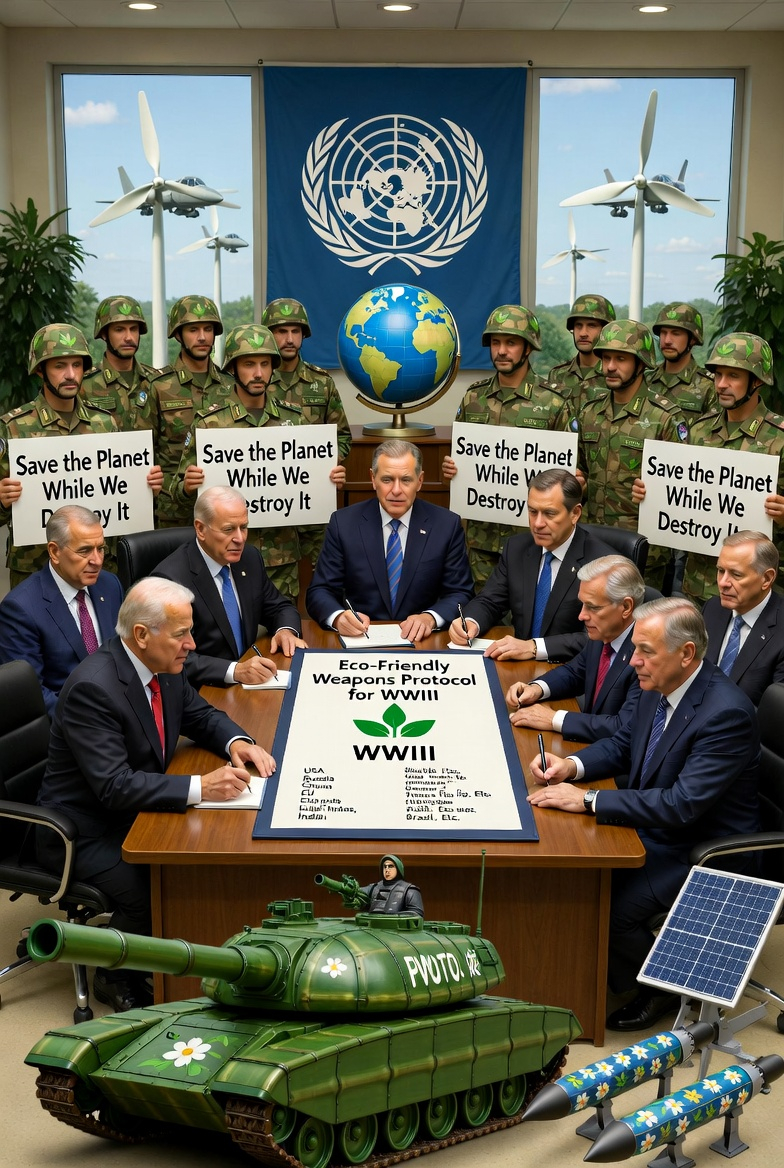
In what diplomats are calling a “historic step for climate responsibility,” leaders of the world’s most heavily armed nations have reportedly agreed that the upcoming World War III must be conducted using environmentally friendly weapons.
The agreement was reached during an emergency summit at the United Nations Secretariat, where representatives from the United States, Russia, China, North Korea, Israel, Iran, Germany and several NATO countries gathered to address what experts describe as the “carbon footprint of modern warfare.”
After hours of intense debate — and several heated arguments over who started the last war — delegates finally agreed that any future global conflict must align with international sustainability goals.
“We cannot save the planet if our missiles keep increasing greenhouse gas emissions,” said one diplomat while carefully separating his war documents into recyclable and non-recyclable folders.
Green Warfare Initiative
Under the newly announced Green Warfare Initiative, all participating countries have pledged to replace traditional bombs and rockets with environmentally responsible alternatives.
Proposed weapons include:
-
Solar-powered missiles that recharge during daylight hours before striking their targets.
-
Electric tanks with zero emissions and optional eco-mode during invasion.
-
Biodegradable bullets that dissolve harmlessly in the soil after use.
-
Carbon-neutral airstrikes, where every bomb dropped will be offset by planting two trees.
A senior military official explained the reasoning behind the initiative.
“If we must destroy each other,” he said, “we should at least do it sustainably.”
Climate Activists Concerned
Environmental groups had earlier raised alarm that the escalating tensions between the United States, Iran and Israel were significantly increasing the planet’s war-related emissions.
According to one climate observer, modern warfare has become “one of the most overlooked contributors to global warming.”
“We are watching rockets fly across the sky releasing tonnes of carbon,” the activist said. “At this rate, World War III could push global temperatures up by another half a degree.”
The new eco-war agreement is expected to reduce the environmental impact of global conflict while maintaining what leaders describe as “a responsible level of destruction.”
UN Praises Commitment
United Nations officials praised the agreement as a major breakthrough.
“This proves that even in times of global crisis, humanity can still come together for the environment,” a UN spokesperson said.
The spokesperson added that the organization is now working on additional guidelines, including:
-
Ensuring battlefield vehicles meet international fuel efficiency standards.
-
Encouraging armies to compost battlefield waste.
-
Introducing recyclable missile casings.
Mixed Reactions
While diplomats celebrated the agreement, some analysts remain skeptical.
One defense expert noted that although the weapons may be eco-friendly, the wars themselves remain extremely unfriendly.
Meanwhile, several arms manufacturers have already announced plans to launch a new line of “organic, cruelty-free military hardware.”
As one world leader reportedly concluded during the meeting:
“We may be on the brink of global war… but at least the planet will appreciate our efforts.”